

For many financial institutions, the move to ISO 20022 has been a major milestone. Payment platforms have been reconfigured to support richer data, structured message fields, and new validation expectations. Messages have been mapped, and the industry now has a stronger foundation for moving payment information with greater clarity and consistency.
That progress matters. But it would be a mistake to treat ISO 20022 as the finish line.
The real challenge is not simply whether a payment message can be formatted correctly. The harder question is whether the organization knows what information it needs to collect for a specific payment, why that information is required, and how those requirements change based on the circumstances of the transaction.
A domestic payment does not carry the same expectations as a cross-border wire. A low-risk client does not raise the same questions as one that requires enhanced due diligence. A payment below a reporting threshold may not need the same information as one above it. The rail matters, the destination matters, the amount matters, the parties matter, and the institution’s own risk policies matter.
ISO 20022 helps define the language of payments. It does not make all of those decisions for the business.
The Standard Gives Structure, But Not the Full Answer
ISO 20022 provides a common structure for payment messages. That is a meaningful improvement, especially in an environment where clean, reliable payment data is critical to compliance, risk management, and operational resilience.
But the standard is only one part of the picture. A financial institution also needs to consider the Usage Guidelines that apply to a specific payment rail, the Regulatory Requirements that may be triggered by the payment, and the Internal Policies that reflect the institution’s own risk appetite and control expectations. These layers do not always line up neatly. A field that appears optional in one context may become required in another. A regulatory obligation may depend on the type of payment, the parties involved, or the value of the transaction. An internal policy may add further requirements based on client tier, geography, or risk profile.
This is why a technical implementation alone is not enough. The organization needs a clear way to translate all of these requirements into a payment intake process that people can understand, operate, and defend.
The Risk of Collecting Everything (or Not Enough)
When requirements become complicated, it can be tempting to solve the problem by collecting more information from everyone. Over time, the intake process becomes heavier, not necessarily smarter.
Clients are asked for information that does not apply to their payment. Frontline teams have to explain questions that feel unnecessary. Operations teams deal with inconsistent data because users are filling in fields they do not fully understand. Compliance teams may still struggle to explain which requirement drove which question.
The opposite problem is just as risky. If intake is too light or too static, the institution may miss information that should have been collected because of a specific rail, threshold, geography, or counterparty. That leads to payment delays, rejected transactions, manual rework, and regulatory exposure.
The goal should not be to ask for the most information possible. It should be to ask for the right information, in the right situation, with a clear reason behind each requirement.
Payment Intake Needs to Be More Adaptive
A stronger approach is to design payment intake around the actual characteristics of the payment. Requirements should change depending on the rail, whether the payment is domestic or cross-border, the value of the transaction, the type of client, and any relevant risk indicators.
When requirements are connected to specific rules, policies, and payment attributes, teams can explain why a field is required. They can see whether the requirement comes from a rail guideline, a regulatory obligation, or internal policy. They can update the process when one layer changes without having to rebuild the entire intake model. They can also provide a clearer explanation to auditors and regulators when questions arise.
“We ask for it because it is on the form” is not a strong answer. A stronger answer is: “We ask for it because this type of payment, under these conditions, triggers this specific requirement.”
This Is a Business Issue as Much as a Technology Issue
It is easy for this conversation to become highly technical because ISO 20022 itself is technical. But the larger challenge is organizational.
Someone needs to interpret the requirements. Someone needs to decide how those requirements should show up in the client or employee experience. Someone needs to keep compliance, operations, technology, product, and frontline teams aligned. Someone needs to maintain the logic as standards, regulations, and internal policies evolve.
Business leaders should be asking whether their organization can explain why each payment field is collected, whether teams are applying requirements consistently, whether client friction is being created unnecessarily, and whether changes can be made without creating a major operational lift every time a rule or guideline changes.
Treating these as technology questions alone misses the point. They are business decisions with direct implications for risk, efficiency, accountability, and the quality of the client experience.
Technical Architecture for Payments Practitioners and Compliance Teams
Once the business has defined which requirements apply, the next challenge is translating that logic into a process and architecture that can apply those requirements consistently. This section details the technical architecture: how intake requirements compose at runtime from four distinct layers, and what that means operationally.
The Technical Architecture: 4 Layers, One Intake Decision
Intake requirements compose at runtime. What a Canadian financial institution must collect for any single payment is not a fixed list pulled from one standard. It is assembled from four layers, conditioned on the payment’s attributes: rail, geography, amount, customer tier, and counterparty type. With Lynx now fully on ISO 20022, the question has moved from format to fit. Not whether the message validates, but what the intake form must actually carry for any given payment.
Think of it as an architecture problem with four levels or layers. Each layer may add requirements the layer below did not anticipate. A team that builds its intake form from any single layer will have gaps in the others.
4-Layer Architecture Requirements by Layer
| Layer 4: The Interior (Bank-Internal Policy) The interior decorating: how the institution finishes the inside for its own clients and risk posture |
The innermost layer is the institution’s own policy: KYC tiering, risk thresholds, business-line conventions, and standing settlement instruction management. Two banks complying with identical Usage Guidelines and identical regulatory obligations may still produce different intake forms, because each institution sets its own thresholds for enhanced due diligence and its own posture toward residual risk. |
| Layer 3: The Zoning Law (Regulatory Overlay) What every payment must satisfy in this jurisdiction, regardless of what the architect drew |
Regulators do not stop at the blueprint. FATF sets cross-border originator and beneficiary data requirements that apply regardless of which Usage Guideline governs the rail. FINTRAC’s travel rule under the PCMLTFA imposes collection obligations on Canadian institutions for transactions above defined thresholds. OSFI adds further requirements at the transaction and counterparty level.
This layer may require fields not present in any Usage Guideline: identity documentation, beneficial ownership, sanctions anchors. |
| Layer 2: The Blueprint (Usage Guidelines) The architectural design for the rail: the plan that says how catalogue elements get assembled on a specific market infrastructure |
Globally, the HVPS+ workgroup governs high-value payment system profiles and the CBPR+ community governs cross-border payment and reporting profiles. Locally, each infrastructure publishes its own blueprint: Lynx and AFT in Canada, Fedwire in the United States, T2, CHAPS, and NACHA elsewhere.
A field optional at the catalogue level can be mandatory under CBPR+, restricted to a narrower code list under a domestic Usage Guideline, or required under HVPS+ for high-value flows. |
| Layer 1: The Catalogue (ISO 20022) Lists message types (pacs.008, pacs.009, pain.001, camt.057, and others), data elements, code lists, and XML encoding rules |
The catalogue is deliberately broad, designed to span every rail, every use case, and every jurisdiction. It defines what is expressible, without prescribing which entries a given payment requires, in which combination, or under which authority.
The implementation stack that determines what a financial institution must actually collect begins above the catalogue. A field optional in the base schema may be mandatory under a Usage Guidelines profile. A field absent from the schema may be required by a regulator as supplementary metadata. In October 2023, BIS CPMI and the Payments Market Practice Group published d230, the harmonized ISO 20022 data requirements for cross-border payments. That report is the explicit acknowledgement that ISO 20022 by itself is not the rulebook. An institution that treats the catalogue as flat ends up either over-collecting fields the rail cannot transport, or under-collecting fields the regulator will later ask for. |
4-Layer Architecture Example
Tracing one Field, Debtor Name, Through the Stack Makes the Layering Concrete
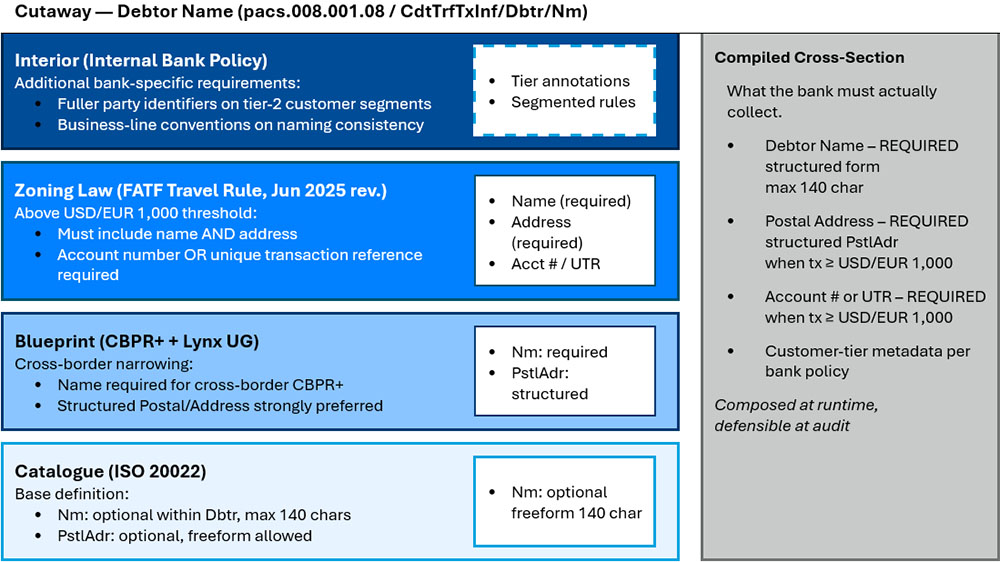
In the Catalogue (ISO 20022): in the published catalogue Debtor Name is optional, capped at 140 characters, and accepts freeform text. An institution reading only the catalogue would conclude the field is discretionary and unstructured text is acceptable. Neither conclusion survives contact with a live rail.
In the Blueprint (CBPR+ and Lynx Usage Guidelines): debtor Name is required for cross-border customer credit transfers, with structured postal address preferred and freeform inputs progressively narrowed each update cycle. Lynx applies HVPS+ harmonization requirements similarly for domestic high-value flows.
Under the Zoning Law (FATF Recommendation 16, revised June 2025): cross-border wire transfers at or above USD/EUR 1,000 must carry the originator’s name, account number or unique transaction reference, and address under FATF Recommendation 16 (revised June 2025). This revision mandates structured address specifically; freeform is no longer sufficient. SWIFT’s November 2026 deadline (SR2026) sharpens this further: CBPR+ will reject messages carrying unstructured address blocks on in-scope cross-border flows. SR2026 is an operational rejection on the rail, distinct from the FATF data-content rule above it.
In the Bank-Internal Policy: KYC tiering may add fuller party identifiers on certain segments: LEI codes on institutional senders, beneficial ownership anchors, supplementary address verification for higher-risk corridors. These appear in no Usage Guideline or regulatory text.
The Compiled Cross Section: for a cross-border wire at or above USD/EUR 1,000, the intake form must collect Debtor Name (structured), Postal Address (structured), account number or UTR, and tier-driven fields per internal policy. None of these requirements derive from any single layer. Intake requirements compose at runtime from all four, and the composed set changes when any layer updates.
The Debtor Name field as a structural beam across all four layers. The compiled cross-section (right) shows what the bank’s intake form must capture for a cross-border wire above USD/EUR 1,000.
Why the Composed System Matters Operationally
A flat system treats every regulator’s fields as universal, so simple domestic flows carry the same intake burden as cross-border wires above the FATF threshold. Forms grow, operations teams stop trusting them, clients abandon onboarding.
A composed system conditions collection on rail, geography, threshold, customer tier, and counterparty type. The form for a domestic Lynx transfer differs structurally from the form for a cross-border CBPR+ wire above USD/EUR 1,000, because the layers conditioning each are not the same.
Threshold-conditioned requirements (FATF’s USD/EUR 1,000 cut-off under Recommendation 16, CBPR+ obligations that apply only on specific message types) are the ones most easily missed when they are not modelled as layer-conditioned rules. Missing them produces rejections, payment delays, and regulatory exposure on exactly the transactions where the data carries the most consequence. A layered model surfaces those requirements precisely because the conditioning is what the model is built on rather than an afterthought layered over a flat list.
When FATF revises Recommendation 16 or SWIFT publishes a CBPR+ update, a flat rule list requires re-engineering the specification from scratch. A layered system absorbs the same revision additively: affected rows are updated, the bands that did not change stay quiet.
The audit trail follows the same logic. A flat system can point only to the aggregated union of every rule it has ever absorbed, with no path back to a specific source. A layered system answers field by field: this requirement comes from CBPR+ Usage Guidelines v3.2 Section 4.7, that one from FATF Recommendation 16 revised June 2025, the next from internal KYC tier policy effective March 2026.
What separates these two postures is not coverage. What separates them is whether the architecture itself encodes the conditioning, or whether the conditioning has been baked into static forms that a future revision will quietly break.
A Final Thought
ISO 20022 has given the industry a stronger foundation for payment data. The next stage of maturity will come from how institutions use that foundation.
For business leaders, this means being able to answer whether your organization can explain why each payment field is collected, whether requirements are being applied consistently, and whether your process can absorb a regulatory update without a full rebuild.
For practitioners, it means building intake architecture where requirements compose at runtime, and where a CBPR+ update or a FINTRAC threshold change moves rows in a table rather than rewriting a form.
The choice is not which fields to collect. It is whether the bank’s compliance posture is flat or composed.
How Can Optimus SBR Help Your Organization?
At Optimus SBR, our Financial Services practice works at this level, translating Usage Guideline updates, FATF revisions, and internal-policy shifts into intake architecture that an auditor can read field by field. ISO 20022 may define the payment language, but institutions still need to decide how that language gets used in practice. The banks that will be best positioned for future regulatory changes are the ones whose intake requirements compose at runtime, where a regulatory threshold change moves rows in a table rather than rewriting a form. The work of the next decade is what gets built above the standard, not the standard itself.
Optimus SBR’s Financial Services Practice
Optimus SBR is a Canadian, independently owned management consulting firm that works with organizations across North America to get done what isn’t. Our Financial Services Group provides strategic advisory, process improvement, risk management, and project management services to support leading financial institutions, insurers, asset managers, and pension funds.
Contact us to learn how Optimus SBR can help your institution build a layered, audit-defensible payment compliance architecture.
Carolyn Kingaby, Practice Leader, Financial Services Group
Carolyn.Kingaby@optimussbr.com
Isabelle Bissonnette, Partner, Financial Services Group
Isabelle.Bissonnette@optimussbr.com






Industry Insights
Service Insights
Case Studies
Company News