

IFRS 18 may not change recognition or measurement, but it could reshape how finance teams classify, govern, explain, and defend performance.
IFRS 18 May Look Like a Presentation Standard. CFOs Should be Cautious About Treating It That Way.
For executives, the implication is clear: IFRS 18 should be treated as a cross-functional reporting transformation, not a financial statement formatting exercise. Organizations that assess the impact early can identify changes to data, systems, controls, performance measures, governance, and stakeholder communications before reporting deadlines create unnecessary risk.
IFRS 18 is effective for annual reporting periods beginning on or after January 1, 2027. Although it does not generally change recognition or measurement, it introduces new requirements for presenting and explaining financial performance. The visible changes include defined categories, new subtotals, enhanced disclosures, and greater consistency in the statement of profit or loss. The less visible, and potentially more significant, impact is the work required across data, reporting processes, controls, governance, and external communications.
| The IFRS 18 Myth versus Reality | |
| MYTH
“It is only presentation.” Because IFRS 18 does not generally change recognition or measurement, implementation may appear limited to financial statement formatting. |
REALITY
Presentation is only the visible output. Classification, reporting logic, management-defined performance measures, audit evidence, and external messaging may all need attention. |
Because IFRS 18 does not fundamentally change recognition or measurement, organizations may underestimate its operational impact. That is the trap.
The implementation challenge is not understanding the standard in isolation. It is determining what IFRS 18 requires across reporting processes, data sourcing, management reporting, performance measures, board materials, and external communications—and coordinating those changes before the first reporting cycle.
Operationally, IFRS 18 may change how performance is classified, assembled, reconciled, governed, and explained. It also raises the standard for supporting management-defined performance measures and aggregated or “other” line items, while increasing the need to align financial statements with management reporting and external performance messaging.
For CFOs, Controllers, and VPs Finance, the central question is not whether IFRS 18 is coming. It is whether the organization is treating implementation as a narrow disclosure update or as a broader reporting initiative that requires clear ownership, early decisions, and disciplined execution before the first reporting deadline.
IFRS 18: What Changes and What Does Not
IFRS 18 replaces IAS 1, but it does not rewrite the fundamentals of accounting. It does not generally change when revenue is recognized, how liabilities are measured, or whether an expense belongs in the financial statements.
That is why the standard can be easy to underestimate. The underlying accounting may remain familiar, but the reporting model behind the financial statements may need to change. For CFOs, much of the implementation effort may sit less in accounting theory and more in the processes, data, and controls that support the new presentation.
| What does not generally change | What does change |
|
|
IFRS 18 introduces a more consistent structure for the statement of profit or loss. Income and expenses will need to be classified into defined categories: operating, investing, financing, income taxes, and discontinued operations. New subtotals will create more comparable anchor points for users of the financial statements. Management-defined performance measures will also need more formal discipline, particularly where organizations use adjusted, underlying, core, or other company-specific measures in public communications.
The new classifications and subtotals may also affect the organization’s performance story. Finance should understand how these changes will align with management reporting, board materials, MD&A, investor communications, earnings materials, and lender reporting.
The intent is straightforward: make financial performance easier to compare and understand. The implementation path is less straightforward.
| IAS 1 Compared to IFRS 18 | ||
| Area | Under IAS 1 | Under IFRS 18 |
| Statement of profit or loss | More flexible presentation | More structured presentation |
| Income and expenses | Less prescribed classification | Classification into defined categories |
| Subtotals | More company-specific flexibility | New defined subtotals and anchor points |
| Management performance measures | Often explained outside the financial statements | Greater disclosure discipline within the financial statements |
| “Other” line items | Often tolerated if broadly described | More pressure to aggregate and disaggregate clearly |
| Implementation effort | Often viewed as a financial statement update | Requires reporting, data, governance, and communication readiness |
The accounting answer may be only one part of the work. The larger question is whether the organization’s reporting model can support the new presentation with enough clarity, consistency, and control.
The IFRS 18 Implementation Trap
The implementation trap starts with a technically accurate statement: IFRS 18 does not generally change recognition or measurement.
That statement is true. It is also incomplete.
For CFOs and finance leaders, the trap is assuming that because the accounting outcome may not change, the implementation can be handled as a late-stage formatting exercise. In practice, that approach may leave Finance trying to resolve classification, data, governance, and communication issues when reporting deadlines are already close.
The number may not change. The path to the number will.
That path matters. Under IFRS 18, finance teams will need to demonstrate how income and expenses have been classified, how new required subtotals have been derived, how management-defined performance measures have been assessed, and how “other” or aggregated line items have been explained. These decisions need to be traceable, supportable, and repeatable.
Audit readiness will also be critical. Finance teams should be prepared to explain what changed, why the new presentation is appropriate, and how key classifications, reconciliations and disclosure judgments are supported by the underlying reporting process.
That is where the work can become more involved than expected.
The implementation effort may be particularly significant for organizations with complex reporting structures, multiple business lines, adjusted performance measures, heavily used “other” categories, or management reporting that does not align neatly with external reporting.
The new presentation requirements may expose gaps in data sourcing, chart-of-account mapping, consolidation models, reporting packages, disclosure templates, board reporting, and external performance messaging.
IFRS 18 should be led by Finance, with coordinated input from FP&A, investor relations, legal, data, internal controls, and audit stakeholders. Finance will remain accountable for the judgments, reporting outputs, governance, and explanations provided to senior management, the board, auditors, and external stakeholders. Clear decision rights, review points, documentation standards, and evidence requirements should therefore be established before the first IFRS 18 reporting cycle.
What Sits Beneath the Financial Statements
The financial statement presentation is the visible change. Beneath it sits the real work: the reporting logic connecting accounts, data, reports, templates, disclosures, performance measures, governance, and controls.
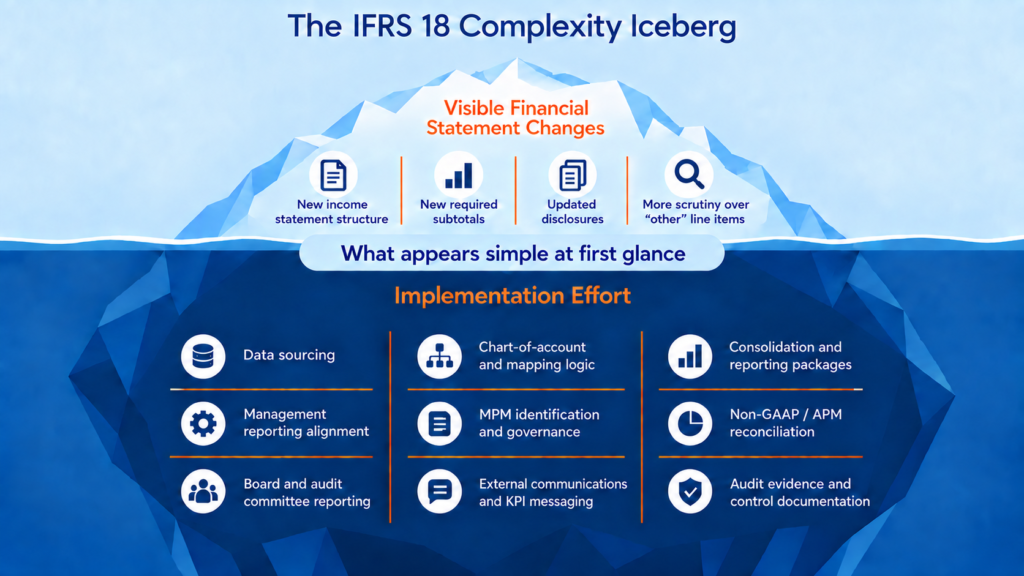
The IFRS 18 Complexity Iceberg
Above the waterline: visible financial statement changes
- New income statement structure
- New required subtotals
- Updated disclosures
- More scrutiny over “other” line items
WATERLINE: WHAT APPEARS SIMPLE AT FIRST GLANCE
Below the waterline: implementation effort
- Data sourcing
- Chart-of-account and mapping logic
- Consolidation and reporting packages
- Management reporting alignment
- MPM identification and governance
- Non-GAAP / APM reconciliation
- Board and audit committee reporting
- External communications and KPI messaging
- Audit evidence and control documentation
For example, an income or expense line that was previously acceptable as part of a broader subtotal may now need to be classified into a defined IFRS 18 category. A commonly used adjusted measure may need a formal assessment to determine whether it is a management-defined performance measure. A line item labelled “other” may need clearer explanation, disaggregation, or evidence supporting why aggregation remains appropriate.
What Readiness Looks Like
A practical readiness test is straightforward: can Finance trace each material income and expense line from source data through its IFRS 18 classification and subtotal to the related disclosure? If not, the organization is facing a reporting readiness issue—not a presentation issue.
Readiness does not mean every technical conclusion is finalized today. It means Finance has a clear view of the decisions to be made, the reporting logic to be updated, the stakeholders to be aligned, and the evidence that will be needed to support the first IFRS 18-compliant reporting cycle.
Readiness extends beyond traceability. For CFOs, a practical assessment should test eight areas across reporting, data, governance, controls, and communications.
CFO Readiness Checklist |
|
| 1. Classification
Can we map each material income and expense line to the appropriate IFRS 18 category? |
2. Subtotals
Do we know how the new required subtotals will change the way performance is presented? |
| 3. Management-defined performance measures
Have we identified which performance measures may qualify as management-defined performance measures? |
4. Reconciliations
Can we reconcile non-GAAP or alternative performance measures to IFRS-defined subtotals? |
| 5. Data and mapping logic
Is the required information available at the right level of detail? |
6. Reporting packages and templates
Which reports, templates, and consolidation outputs need to be updated? |
| 7. Governance and audit readiness
Who owns the key judgments, and what evidence supports them? |
8. External messaging
Will the way we explain performance externally still align with the financial statements? |
If the answer to most of these questions is “not yet,” IFRS 18 is probably larger than a disclosure update for your organization.
These questions are not meant to create unnecessary complexity. They are intended to surface where IFRS 18 may require focused work before reporting timelines become a constraint. Having the data somewhere is not the same as being ready. Finance needs the data at the right level of detail, structured and mapped to support classification, subtotals, disaggregation and review.
Start with an IFRS 18 Impact Assessment
A practical executive response is to begin with three steps: establish accountable sponsorship, complete an impact assessment across reporting and communications, and agree on a phased implementation plan with decision points, owners, and milestones. This creates visibility into the scale of the change before detailed design begins.
IFRS 18 does not need to create unnecessary disruption. But it does require early clarity.
Organizations will be better positioned to manage the transition if they understand where the standard creates real implementation effort, where existing reporting practices are already strong, and where focused work is needed.
That starts with an impact assessment.
An IFRS 18 impact assessment should identify changes required across the statement of profit or loss, management-defined performance measures, reporting packages, data and mapping logic, governance, audit evidence, and external communications. It should distinguish technical accounting decisions from operational implementation requirements and provide CFOs, Controllers, and VPs Finance with a prioritized roadmap of actions, owners, dependencies, and timing.
How Optimus Can Help You Move from IFRS Awareness to Readiness
Optimus SBR helps finance leaders assess the impact of IFRS 18 and translate technical requirements into an executable implementation plan. Our support can span reporting and data analysis, process and control design, governance and documentation, board and audit committee materials, and stakeholder communications.
To understand what IFRS 18 could mean for your organization Contact an Optimus SBR Financial Services consultant for a 30-minute IFRS 18 impact assessment discussion.
Early action gives Finance more control over implementation choices, more time to align stakeholders, and greater confidence in the first IFRS 18 reporting cycle.
Optimus SBR’s Financial Services Practice
Optimus SBR is an independently owned Canadian management consulting firm that works with organizations across North America to execute what’s next. Our team partners with leading financial institutions, ranging from major Canadian banks to insurers and regional credit unions, turning strategy into execution and delivering measurable results.
Learn how we can help streamline your organization’s transition to IFRS 18.
Carolyn Kingaby, Practice Leader, Financial Services
Carolyn.Kingaby@optimussbr.com
Farshid Buhariwalla, CPA, CA, Principal, Financial Services Practice
Farshid.Buhariwalla@optimussbr.com






Industry Insights
Service Insights
Case Studies
Company News